
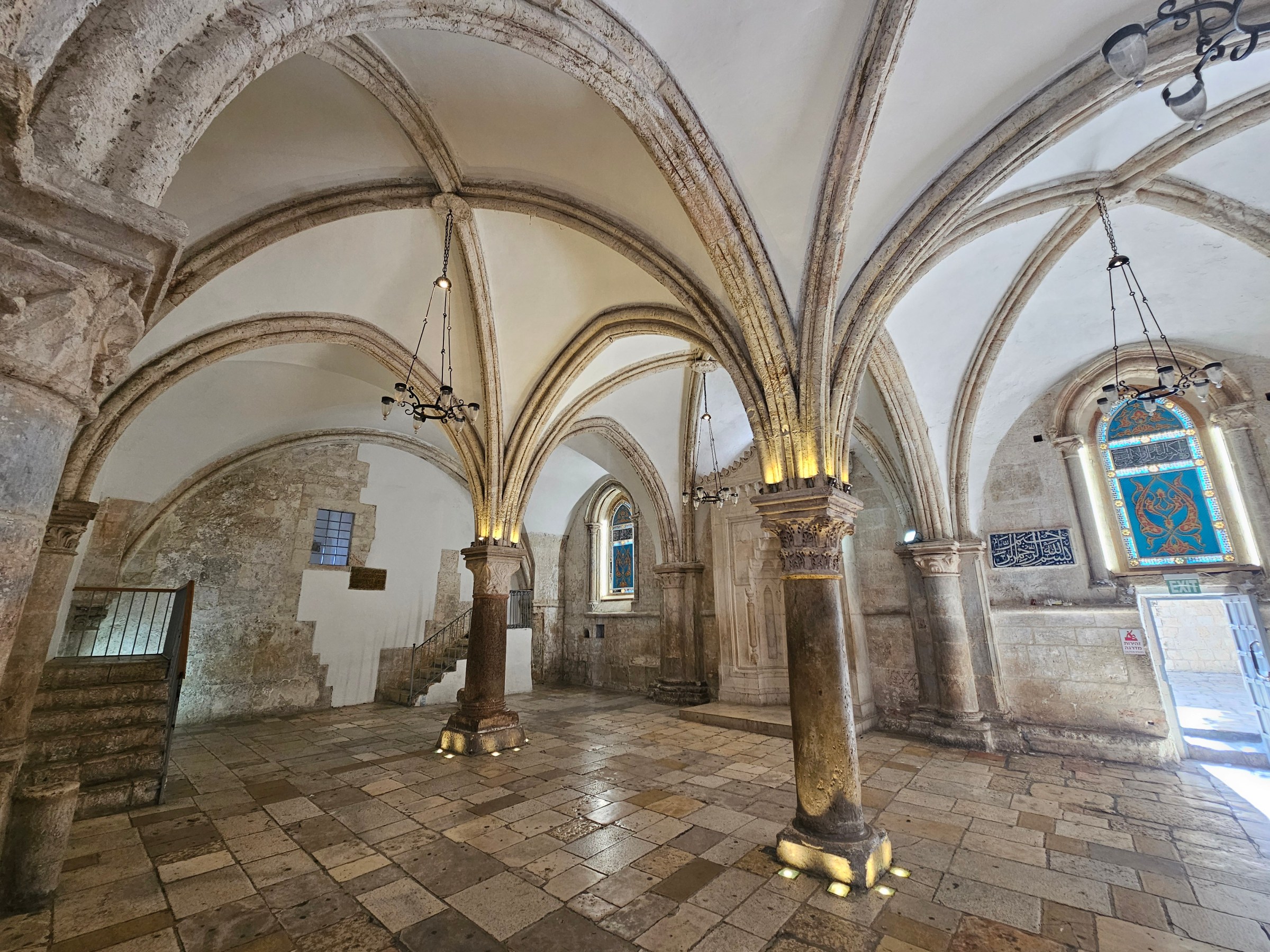
The Cenacle in Jerusalem: Where Covenant, Presence, and Mission Converge
On the western hill of Jerusalem, on Mount Zion, stands a modest stone hall known to Christians as the Cenacle (Upper Room). From the outside, it appears simple, almost understated. Yet for Protestant Christians, this space speaks profoundly—not because of relics or ritual, but because of what God did here through His Son and by His Spirit.
The Upper Room is remembered as the place where Jesus shared His final Passover meal with His disciples, where the New Covenant was declared, where fear was transformed into faith after the resurrection, and where the Holy Spirit empowered the Church at Pentecost. Few places in Jerusalem so clearly unite Scripture, salvation, and sending.
A Room Prepared by God
The Gospels tell us that shortly before His crucifixion, Jesus instructed His disciples to prepare a room in Jerusalem for the Passover meal:
“He will show you a large upper room, furnished and ready.” (Mark 14:15)
It was here that Jesus reclined at table with the Twelve on the night before His death (Luke 22:14). During this meal, He took bread and wine and gave them new meaning:
“This is my body given for you; do this in remembrance of me.”
“This cup is the new covenant in my blood.” (Luke 22:19–20)
For Protestant believers, these words emphasize remembrance rather than repetition. The focus is not on an ongoing sacrifice, but on Christ’s once-for-all work on the cross. The Upper Room thus becomes the birthplace of a faith centered on grace alone, through faith alone, in Christ alone.
John’s Gospel adds further depth to this moment. In chapters 13–17, Jesus washes His disciples’ feet, teaches about love and humility, promises the coming of the Holy Spirit, and prays for all who will believe in Him. In this intimate setting, the heart of Christian discipleship is revealed: loving service, obedience to God’s Word, and unity rooted in truth.
From Fear to Faith: The Risen Christ Appears
After the crucifixion, the disciples returned to Jerusalem shaken and afraid. The Gospel of John describes them gathered behind locked doors:
“The disciples were together, with the doors locked for fear…” (John 20:19)
It was into this fearful gathering that the risen Jesus appeared. He spoke peace, showed them His wounds, and breathed on them, saying, “Receive the Holy Spirit” (John 20:22). The Upper Room thus becomes a place of restoration and commissioning. Failure is met with grace, fear with peace, and confusion with calling.
This moment reminds Protestant believers that Christ does not wait for perfect faith before He reveals Himself. He meets His followers where they are and sends them forward transformed.
Pentecost: The Birth of the Church
The Book of Acts tells us that after the ascension, the disciples continued to gather in an upper room in Jerusalem:
“They all joined together constantly in prayer.” (Acts 1:14)
On the day of Pentecost, as they waited in obedience, the Holy Spirit descended with power:
“They were all filled with the Holy Spirit and began to speak in other tongues as the Spirit enabled them.” (Acts 2:4)
Christian tradition associates this event with the Cenacle. Here, the waiting community became a witnessing Church. The Gospel moved outward—from Jerusalem to Judea and Samaria, and ultimately to the ends of the earth (Acts 1:8).
For Protestants, Pentecost affirms essential truths: the active work of the Holy Spirit, the priesthood of all believers, and the calling of every Christian to participate in God’s mission.
History and the Physical Space
While archaeology cannot conclusively prove that the present structure is the exact room of the Last Supper, early Christian tradition consistently located these events on Mount Zion. The current building largely dates to the Crusader period (12th century), with later Islamic and Ottoman influences.
The architecture is simple: stone walls, Gothic vaults, and an uncluttered interior. This simplicity resonates deeply with Protestant spirituality. With no altar or iconography dominating the space, the room invites reflection on Scripture, prayer, and the living presence of Christ rather than on objects of devotion.
A Living Message for Believers Today
The Cenacle is not merely a site to be remembered; it is a message to be lived. It speaks of a table where grace is offered, a room where fear is replaced by peace, and a gathering that becomes a global mission.
Here, Jesus taught His followers to serve rather than rule:
“I have set you an example that you should do as I have done for you.” (John 13:15)
Here, He prayed for unity among all believers:
“That they may all be one… so that the world may believe.” (John 17:21)
And from here, the Spirit sent ordinary men and women to carry an extraordinary message to the world.
Conclusion
The Cenacle on Mount Zion stands at the crossroads of Christian faith: the cross behind it, the resurrection within it, and the mission flowing from it. For Protestant Christians, it is a powerful reminder that the Church was born not through ceremony or institution, but through obedience, prayer, Scripture, and the work of the Holy Spirit.
Jerusalem was the beginning—but the calling continues.
“Not by might nor by power, but by my Spirit,” says the Lord Almighty. (Zechariah 4:6)
From an upper room in Jerusalem, God changed the world—and He is still at work today.